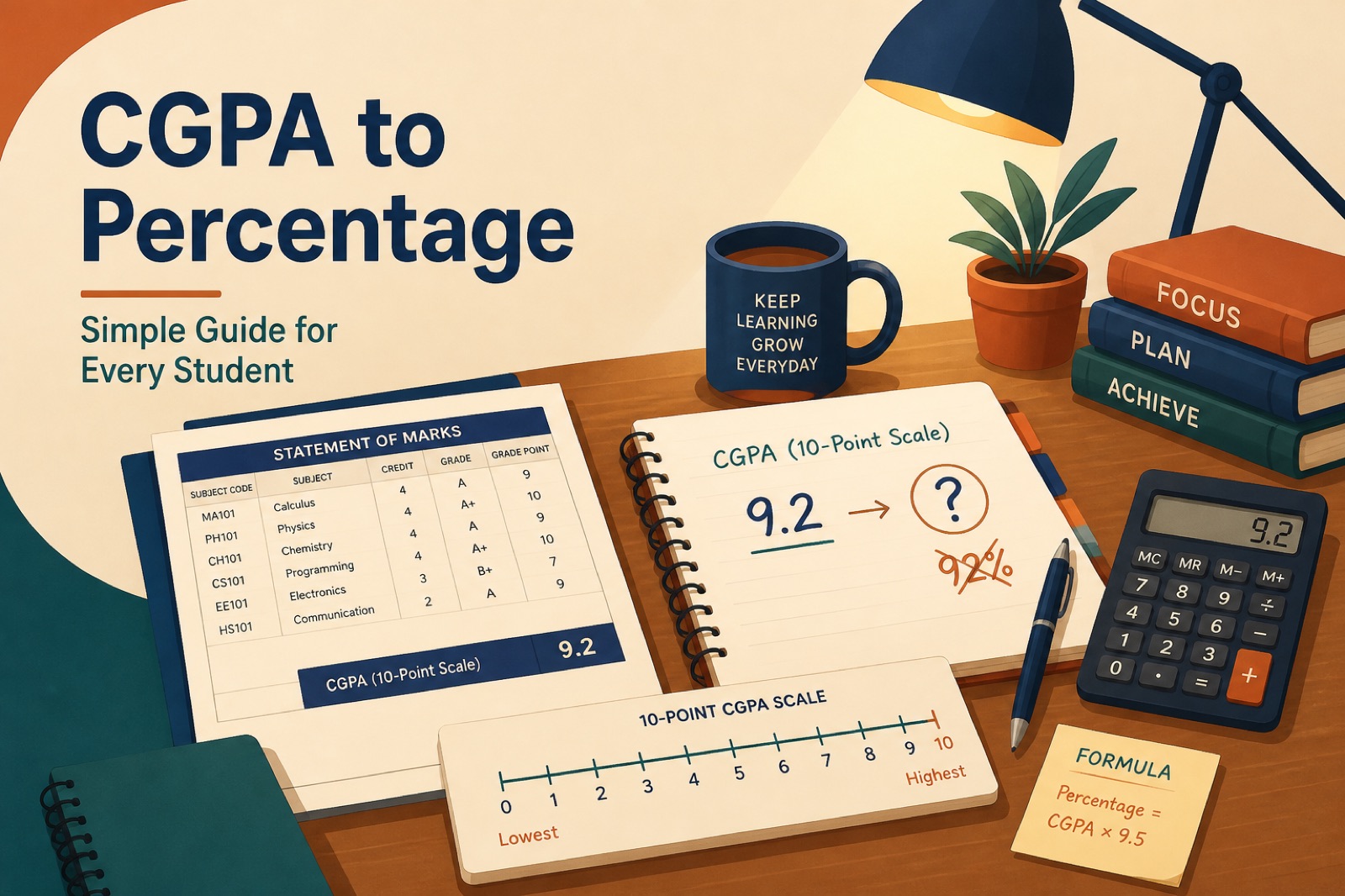
Students hear “just multiply CGPA by 10” and “use 9.5” in the same group chat. Both can be true — for different universities. A 9.2 CGPA is 92% on a ×10 rule and 87.4% on a ×9.5 rule. That gap is large enough to change a cutoff.
This is a study-math explainer, not an official conversion certificate. Always prefer the footnote on your grade card. Utila’s CGPA calculator is for checking common formulas, not for overriding your registrar.
What CGPA actually is
CGPA (cumulative grade point average) is usually a credit-weighted average of grade points, not an average of percentage marks. Two students with the same semester percentages can land different CGPAs if credit hours differ.
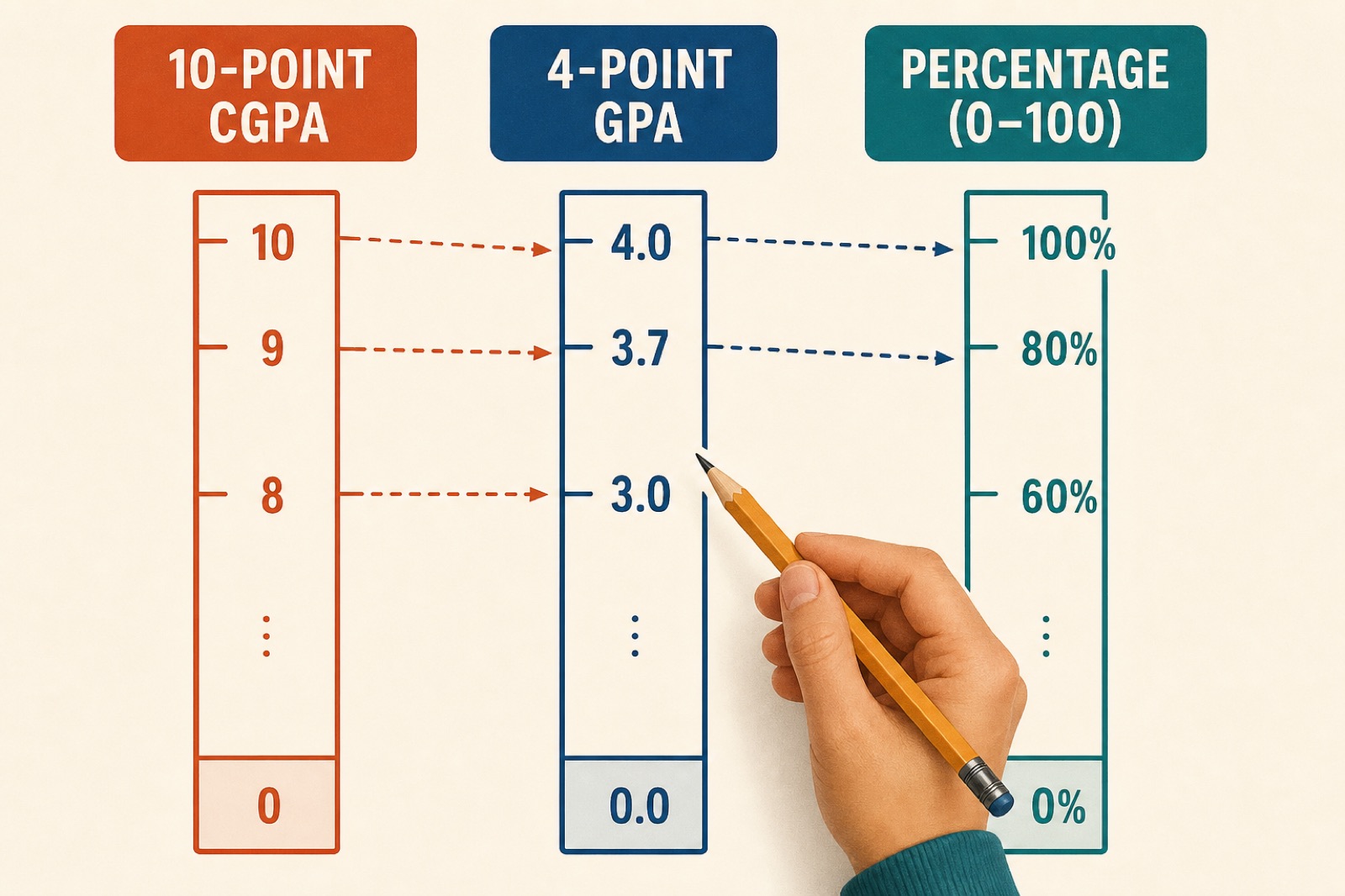
GPA on a 4.0 scale (common on US-style transcripts) is a different ladder again. Do not paste a 10-point CGPA into a 4.0 box.
Common conversion rules (and who uses them)
There is no single national formula. These are patterns you will see. Confirm yours.
| Pattern | Example on 9.2 CGPA | What to verify |
|---|---|---|
| Percentage ≈ CGPA × 9.5 | 87.4% | Often cited for some 10-point boards / universities |
| Percentage ≈ CGPA × 10 | 92% | Simple, and often wrong if your ordinance says 9.5 |
| Range table (9.0–10 = 80–100, etc.) | Depends on the band | Used when grade points map to mark ranges |
| Credit-weighted % from each paper | Unique to you | Closest to “real” marks if you still have paper scores |
If a form wants percentage of marks obtained, and your university only prints CGPA, look for an official conversion circular. Do not invent ×10 because it looks round.
GPA 4.0 is not CGPA ÷ 2.5
A 10-point 8.0 is not automatically a 3.2 on a 4.0 scale (8 ÷ 2.5). Some credential evaluators use their own tables. Some universities publish an official 10-to-4 mapping. If a foreign application asks for GPA, follow their instructions, then keep a GPA calculator for US-style credit hours when that is the system you are actually in.
When you still have raw marks
If you have subject marks, you can compute percentage the ordinary way: total obtained ÷ total maximum. A percentage calculator is enough. That number may not match CGPA × 9.5, because grade points are often awarded in bands (for example 85–100 all map to 10).
For a live paper — “what do I need on the remaining exam?” — use a grade calculator with the weights your syllabus prints. CGPA conversion will not tell you that.
A practical checklist for forms
- If the form says CGPA, enter CGPA. Do not convert unless they ask.
- If it says percentage as awarded by the university, copy the university’s converted figure or formula.
- If it says percentage of marks and you have marksheets, compute from marks.
- Save a screenshot of the ordinance or grade-card footnote next to the application.
- Never “round up” 87.4% to 90% because a cutoff sits at 90.
Bottom line
9.2 looks like 92 because both use the digit 9. The conversion is a published rule, not a visual rhyme. Check the scale, check the footnote, then use a calculator only to test the arithmetic. Your transcript remains the source of truth.