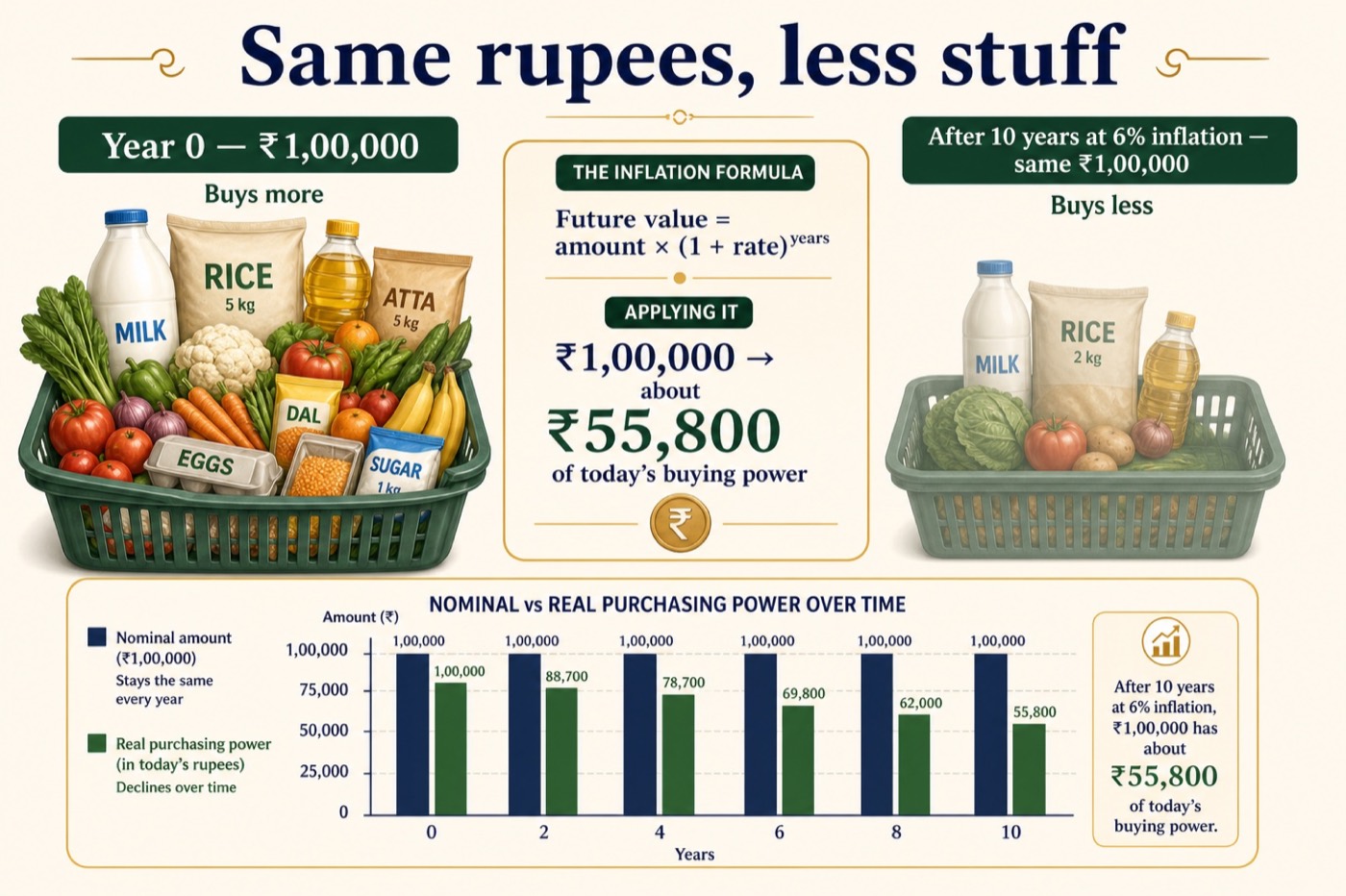
A ₹1,00,000 cash stash looks unchanged on a passbook. In a kitchen it does not. If prices rise, nominal rupees stay the same and real rupees — what those notes buy — shrink. That gap is inflation. It is not a market hot take. It is division.
This article is educational math, not investment, tax, or product advice. Assumptions are yours to pick. Utila’s inflation calculator is for testing those assumptions in the browser.

Nominal vs real in one line each
Nominal is the number printed on the note or the account screen.
Real is that number after you adjust for a price level — “how much stuff.”
If milk goes from ₹40 to ₹70, the same ₹70 that once bought almost two litres now buys one. Your “safe” cash did not steal itself. Prices moved.
A 10-year example at 6%
Use decimals (6% = 0.06). Approximate buying power of a cash amount left unchanged:
Today’s value ≈ amount ÷ (1 + rate)^years
₹1,00,000 ÷ (1.06)^10 ≈ ₹1,00,000 ÷ 1.7908 ≈ ₹55,800 of today’s purchasing power.
| Years | Cash still in the drawer | Buying power in today’s ₹ (at 6%) |
|---|---|---|
| 0 | ₹1,00,000 | ₹1,00,000 |
| 5 | ₹1,00,000 | ≈ ₹74,700 |
| 10 | ₹1,00,000 | ≈ ₹55,800 |
| 15 | ₹1,00,000 | ≈ ₹41,700 |
The drawer did not lose digits. The grocery basket got smaller. That is the whole illustration.
What people mix up with compounding
Compound interest answers “what does this balance become if it grows?” Inflation answers “what can that balance buy if prices grow?” You can have both: a savings rate and an inflation rate. A 7% return with 6% inflation is not “7% richer in the market of things.” The rough real gap is in the neighbourhood of one percentage point — and even that is a classroom shortcut, not a tax-aware return.
SIP and savings tools project contribution paths. They do not cancel inflation unless you put inflation in the story on purpose. Pair a SIP calculator or savings calculator with an inflation check when the question is “will this still cover the same rent or fees?”
Loans, EMIs, and the wrong comfort
Inflation can make a fixed EMI feel lighter in later years if your income rises with prices — that is a different sentence from “borrowing is free.” Tenure, fees, and total interest still decide whether a loan is expensive. Run the installment in an EMI calculator, then keep inflation as a prices question, not a permission slip.
Percentage moves (a 10% price jump) are ordinary percentage math. Inflation over many years is repeated percentage — which is why the exponent shows up.
A desk check that stays honest
- Write the cash number you call “emergency” or “idle.”
- Write a conservative annual inflation rate you are willing to defend (not a social-media extreme).
- Pick a horizon you actually care about (5, 10, 15 years).
- Compute remaining buying power.
- If the smaller basket would break a plan, the plan was named in nominal rupees.
Bottom line
Cash is a number. Purchasing power is a basket. Inflation is the wedge between them. Convert before you call a stash “enough,” and convert again when the horizon is long. The inflation calculator keeps the arithmetic in your browser so a round lakh cannot hide a thinner grocery list.