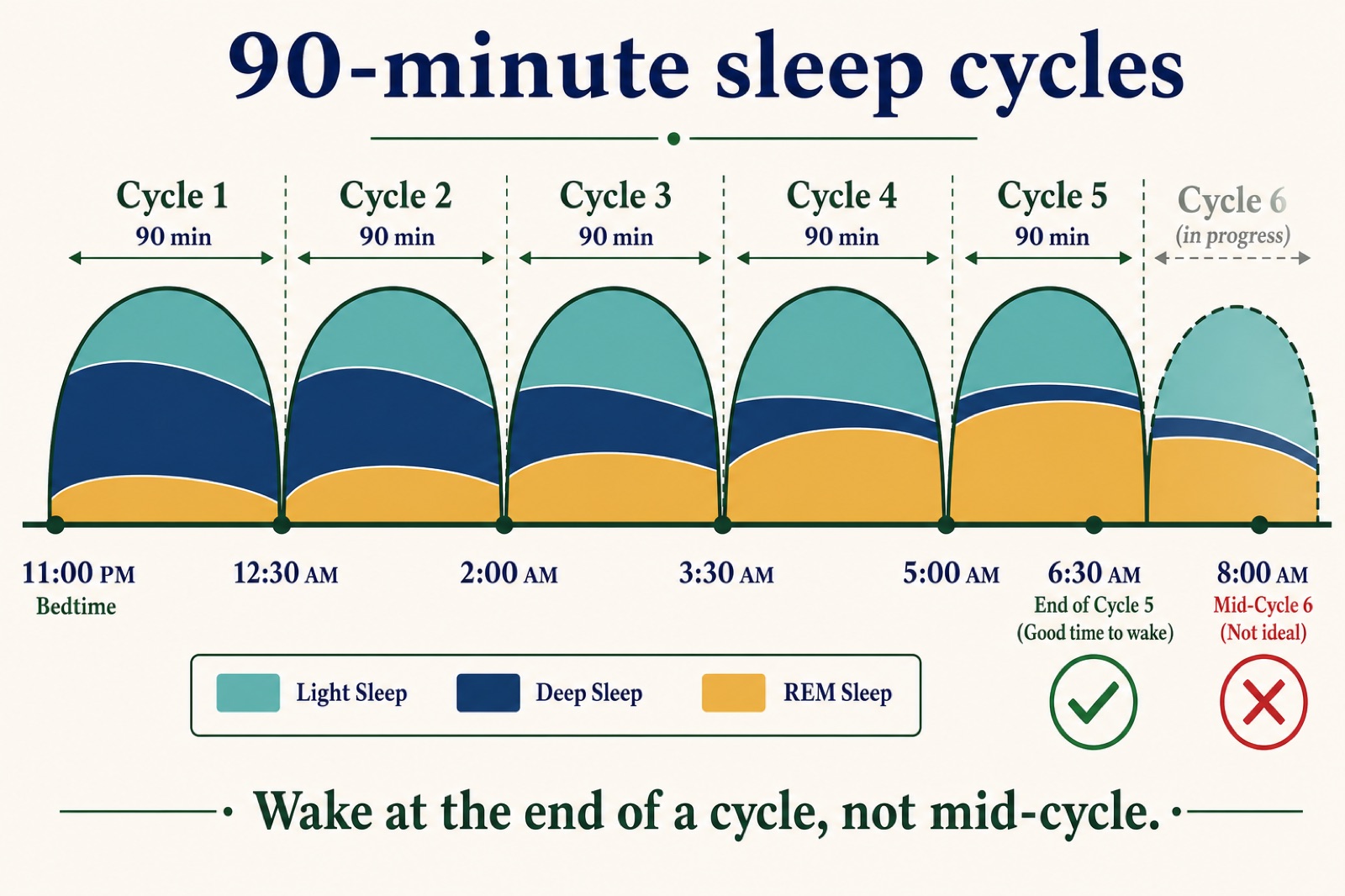
Eight hours is a slogan. A sleep cycle is a sequence. Most adult nights are described as repeating blocks of roughly 90 minutes — light sleep, deeper sleep, then REM — not a flat bar you fill until the clock hits 8:00.
That is why 7.5 hours (five cycles) can feel clearer than eight hours that end in the middle of the next block. You did not “win” by sleeping less. You woke closer to a boundary. Utila’s sleep calculator uses that 90-minute pattern plus a short fall-asleep buffer. It is a planning aid, not a diagnosis.

What a cycle actually is
A cycle is a trip through lighter sleep, slower-wave sleep, and REM. Early cycles often hold more deep sleep. Later cycles often hold more REM. The popular “90 minutes” figure is an average used for planning, not a promise that your third cycle will land on the minute.
If you fall asleep at 11:15 p.m.:
| Cycles | Sleep time | Approximate wake |
|---|---|---|
| 4 | 6.0 hours | 5:15 a.m. |
| 5 | 7.5 hours | 6:45 a.m. |
| 6 | 9.0 hours | 8:15 a.m. |
Add the time it actually takes you to fall asleep. Utila assumes about 15 minutes. A 11:00 p.m. lights-out with a 15-minute buffer and five cycles is a 6:45 a.m. suggestion, not a 6:30 one. Run your own bedtime in the calculator rather than memorising someone else’s chart.
Why the 8-hour alarm still fails people
Clock hours count time in bed or time asleep. They do not ask where in the cycle the alarm fires. Waking from deeper sleep is the groggy feeling people call sleep inertia. An extra 30 minutes can be the difference between finishing cycle five and interrupting cycle six.
The fix is not “always sleep 7.5 hours.” Some people need more cycles. Shift work, illness, and caregiving wreck tidy math. The useful habit is:
- Pick the wake time you actually have to hit.
- Count backwards in 90-minute steps.
- Leave a fall-asleep buffer.
- Protect the last cycle you can realistically finish.
Pair sleep with the rest of the day honestly
Sleep is not a closed system. A huge calorie deficit, dehydration, or a resting heart-rate spike after illness can make the same 7.5 hours feel worse. If you already track other numbers, keep them informational:
- Energy intake is an estimate in a calorie calculator or BMR calculator — not a prescription.
- Hydration targets from a water intake calculator are planning ranges.
- Heart-rate zones from a heart rate calculator are training math, not a sleep study.
None of those tools replace a clinician if you cannot stay awake while driving, if a partner hears gasping, or if nights have been broken for weeks.
A 10-minute experiment (one week, not forever)
- Night 1–2: write lights-out, estimated sleep onset, and how you felt 20 minutes after waking.
- Night 3–5: set the alarm to the nearest cycle boundary the calculator suggests for your fixed wake time.
- Keep the same caffeine cutoff if you can, so you are not testing two variables.
If 5 cycles leave you wrecked, try 6. The article’s point is the boundary, not a shorter night as a personality trait.
Bottom line
Clock hours measure duration. Cycles describe structure. Aim the alarm at the end of a cycle you can actually finish, include time to fall asleep, and treat the result as a plan you can revise. The sleep calculator runs in your browser so you can test bedtimes without uploading a sleep log.